October 10, 2026
How We Split Our Kids' Money
We recently changed how we split our kids’ money when they get paid for chores. Previously, the split was 10% Give, 50% Save, 40% Spend. Coupled with that breakdown, we had what we called the "Spark Store".
Before they had enough money, our children could pick out up to two items (usually toys) that they wanted to work toward. We agreed to pay 50% of the cost. They paid the other half. Those items sat on a designated shelf as a visual incentive until they earned enough from chores to pay their half.
That system worked well for over a year. Especially for our younger children. Having a tangible, visible goal makes a huge difference.
Over time, Tymber and I began to realize that our incentives were misaligned with our values. We were incentivizing spending, while what we actually wanted was to cultivate intentional choice, patience, and a healthy balance with money.
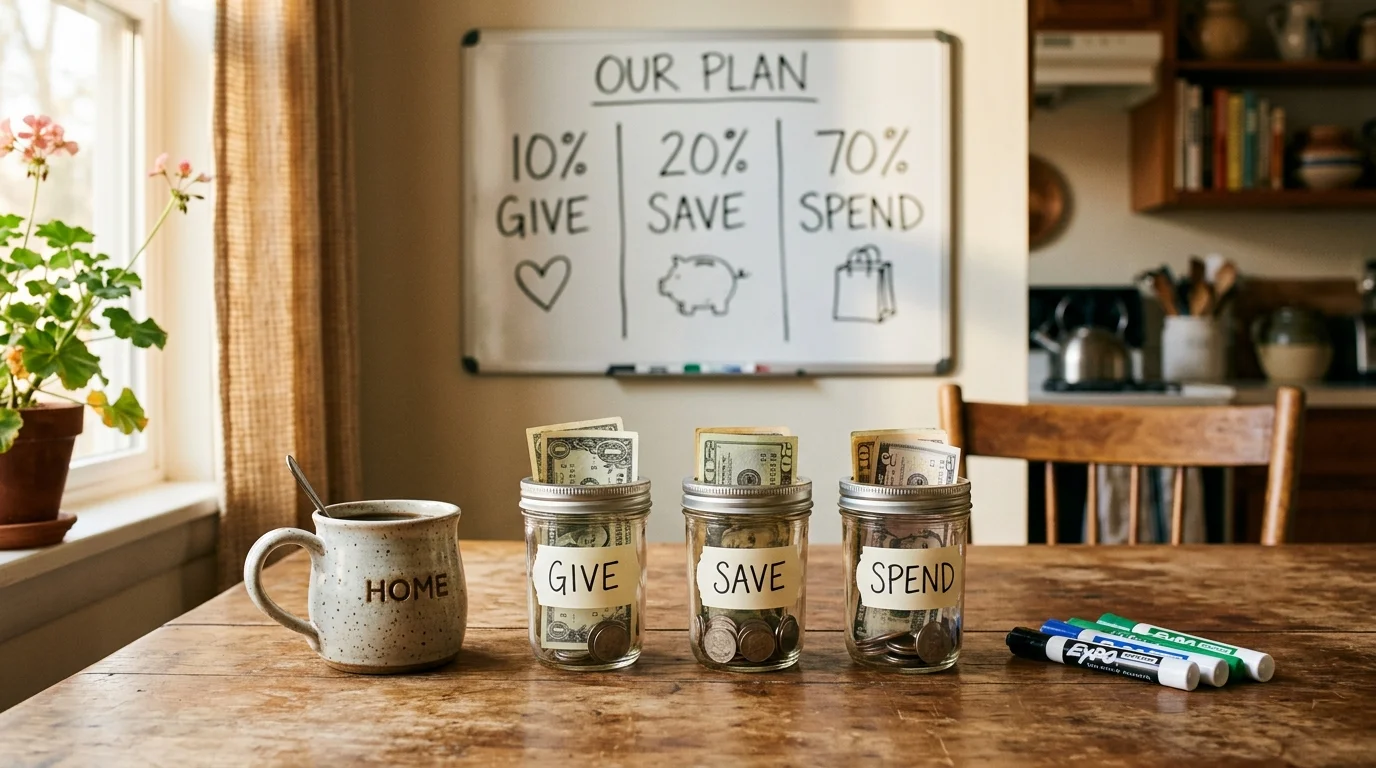
So at breakfast one morning, we held a family council. I grabbed a dry-erase marker and drew our familiar budget breakdown on the whiteboard that hangs by our kitchen table. A system my children know well.
I explained why it didn't feel right. Then, I laid out a new proposal.
The Old Model: Subsidizing the Spark Store
Under our original system, purchases were heavily subsidized:
- 10% Give
- 50% Save
- 40% Spend
All items purchased through the Spark Store were 50% off for the kids. Mom & Dad paid the remaining half.
What that looked like for a $10 payday
When a child earned $10, their paycheck was divided:
- Give (10%): $1.00
- Save (50%): $5.00
- Spend (40%): $4.00
Now, imagine they wanted an $8 toy:
- The child used all $4.00 of their spending money.
- Mom & Dad covered the other $4.00 (the 50% Spark Store discount).
- Total value to the child: $14.00 ($10 earned + $4 Spark Store discount).
That meant the child unlocked up to 40% extra value. But only if they chose to spend their money. If a child chose patience and left their money alone, they received no matching bonus. Without realizing it, our system rewarded consumption over thinking long-term.
The New Model: Rewarding Matched Savings
Our new model flips the incentive. We expanded discretionary spending so our children learn the real-world purchasing power of a dollar, removed the Spark Store, and offered a match on voluntary savings instead:
- 10% Give
- 20% Save
- 70% Spend
Two Core Rules
- No more Spark Store: All items are paid 100% by our children. Mom & Dad pay $0 toward purchases.
- Savings match: Mom & Dad match 100% of any discretionary spending money the child chooses to deposit into their savings account instead of spending it.
Rather than handing out free money on purchases, we reward the conscious decision to save.
What that looked like for a $10 payday
When a child earns $10, the breakdown is:
- Give (10%): $1.00
- Save (20%): $2.00
- Spend (70%): $7.00
From there, the child decides what happens next:
Scenario A: Spend it all
- The child buys a $7 toy.
- The child pays the full $7.00 from their spending money. Mom & Dad pay $0.00.
- Total value gained: $10.00 ($1 Give + $2 Save + $7 Spend).
Scenario B: Save it all (for a full match)
- The child chooses to save their $7.00 of spending money instead.
- Mom & Dad match that choice with another $7.00.
- Total placed in the child's savings: $16.00 ($2 base + $7 voluntary from spending + $7 parent match).
- Total value gained: $17.00 ($1 Give + $16 Total Savings).
Under the old system, our kids received up to 40% extra value, but only by buying something. Under the new plan, they can earn up to 70% extra value. And that bonus is unlocked entirely by their own decision to invest in their future.
Comparing the Two Models
| Dimension | The Old Model (Spark Store) | The New Model (Matched Savings) |
|---|---|---|
| Budget Split | 10% Give / 50% Save / 40% Spend | 10% Give / 20% Save / 70% Spend |
| Purchases | 50% subsidized by Mom & Dad | 100% paid by the child |
| Parent Contribution | Matched purchases | Matches voluntary savings |
| Max Bonus on $10 | +$4.00 (40% bonus unlocked by spending) | +$7.00 (70% bonus unlocked by saving) |
| Core Habit Rewarded | Purchasing | Patience, intentionality, and saving |
What Happened at the Table
After running through the math on the whiteboard, the kids loved the new proposal.
My 8-year-old’s eyes lit up when he saw how much spending money he'd have! And honestly, I'm okay with that. He is learning what things actually cost. If he wants to buy something, he pays full price for it and feels the true trade-off of that purchase. But when he decides to pause, tuck that money away, and watch Mom and Dad double it, he experiences intentional saving.
I want to empower our children to make real financial choices. And guide them as they learn from the outcomes.
Every family is different. I don't expect anyone else's budget to mirror ours. I invite you to ask:
- What does our family value?
- Do our family systems align with those values?
- What does our family need at this time?
If you sense friction around money, or feel like your current setup has outgrown its season, bring it to a family council. Pull up chairs around the kitchen table or sit comfortably on the couch. Have a candid discussion about what's working well and what can be improved. Ask your children what they think. Kids have more wisdom than we often give them credit for, and their ideas might just surprise you.